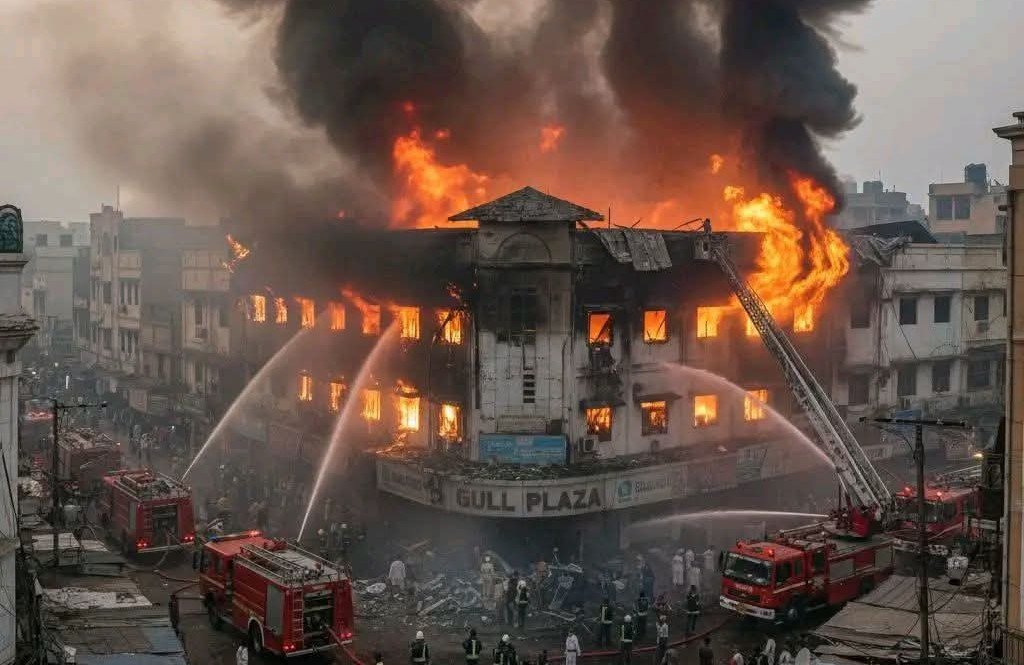
On the night of 17th January, Gul Plaza in M.A. Jinnah Road, Karachi, was engulfed in a massive fire, not only the occupancy of a commercial building was lost but also the additional trust that citizens had in a system which has normalized disaster that was avertable.
How Gul Plaza Exposed a City Without a State. What started as a fire in one store quickly extended to a full-blown multi-storey market, where people lived, vacating their homes, ruining their means of living, and again revealing how unsound the construction of the largest city of Pakistan was. With the smoke over Saddar and rescue workers struggling with the fire over a day, the picture became in all too familiar: sirens, families losing loved ones, the exhausted firefighters, and the authorities promising investigation.
The Gul Plaza fire initially seems to be just another addition to the long list of Karachi city-related disasters, that happened because of poor wiring, illegal extensions, and combustible inventory placed in old buildings. Nevertheless, it is a mistake to look at it as a one-off incident without a greater political and strategic meaning. This was not just a failure in infrastructure, still, it was a governance failure, an accountability failure, and a strategic indicator of how perilously empty the urban management system in Pakistan is.
Karachi: Economic Powerhouse of Pakistan
Karachi is not a normal city. It is the economic powerhouse of Pakistan that provides a significant portion of the national income, is home to major ports, banks and industrial estates and supports millions of livelihoods in both the formal and informal trade. Markets like Gul Plaza cannot be described as only a grouping of shops, but as economic ecosystems. Their demolition is not only a personal loss to the shopkeepers but also a national outrage to the jobs, supply chain, and the income of families. When a space like this is destroyed by fire, the expenses are not only covered in the blackened walls but also in economic insecurity in the long term of hundreds of families.
It is reported that the fire began with an electric short somewhere in a shop where flammable materials were stored, which is so typical of older Karachi commercial areas that it barely attracts attention. The majority of them do not contain a sprinkler system, working fire exit, smoke alarm, or even a casual observation of the safety codes. These are not under wraps, they are open, recorded and publicized problems. However, every year, the markets are running without any substantial inspections, upgrades, or enforcement. It is not regulatory blindness it is regulatory abandonment.
Another systemic weakness was also demonstrated by the response capacity. Fire fighters had to fight narrow street, traffic jam, low water pressure and building design that enhanced faster spread of flames.
Disorganized Coordination & Confusion
There was disorganized coordination, delays, and confusion, according to eyewitnesses. When fire fighters were busy being heroes in deadly circumstances, courage cannot replace modern equipment, sufficient manpower as well as a developed strategy of disaster response to the city. Inability to contain a fire in one of the most central business areas of the country is an indication of not only a failure in operations but a breakdown of the urban preparedness.
The post-war political situation was depressingly predictable. The provincial and federal leaders made condolences; committees were declared; investigations were to be promised; packages of compensation were to be discussed. The oratory was so solemn, sympathetic, and comforting. But the people of Karachi have read this play before, when factories, markets, buildings, and floods took place. The repetition itself has become a kind of political theatre, the grief of the people and the performance of responsibility, and the institutional forgetfulness.
The most unveiling aspect of Gul Plaza is that it reveals the utter lack of connection between the state priorities and the urban reality. Governments talk endlessly of mega-projects, highways, ports, digitalisation and investment corridors. The simplest of all levels of urban administration, though, to make sure that the premises are not turned into death traps, is criminally overlooked. This is an erroneous strategic miscalculation. The impossibility of safeguarding the daily economic spaces by a state means it is not developing sustainable development.
Political Economy of Neglect
Another theme in the tragedy is the political economy of neglect. A lot of market buildings are placed in legal grey zones which are informed by informal relations, bribery, and selective enforcement. The inspections can be controlled at times. Abuses are condoned in case rent moves upwards. In the long term, it forms a fatally diverse ecosystem, where unsafe structures are accepted as the rule, and safety is a choice. In the event of a catastrophe, accountability is decentralized among agencies, departments and decades of bad governance until nobody is accountable at all.
Not confined to the governance, there is a more significant strategic weakness that with this fire, Pakistan has failed to control urban risk in the most crucial city. Risk in security discourse is usually viewed in terms of military or geopolitical risk, but urban disasters also form part of strategic risks. They weaken societies, ruin economic confidence, undermine investor trust and strengthen the sense of state ineptitude. A city that burns and floods and collapses again is not simply mismanaged at all, it is destabilized.
Another aspect that cannot be brought out by a report of inquiry is the human aspect. Majority of shop owners in Gul Plaza were not corporate giants; they were small traders who had invested money that was saved in small businesses. They lost their stock, records and funds in one night. Such losses are not one-time misfortunes in a nation where culture of insurance is weak and there is lack of social protection. To a large number of families, it is a fire that means years of debt, unemployment and loss of social mobility.
State Cannot Be Trusted?
Tactically, long-term consequences of the multiple destruction of business centers are strategic. It deters any formal investment and strengthens informality. Moreover, it drives companies to work without regulations since being regulated does not guarantee any security. It educates the people that the state cannot be trusted to implement security or to bring justice in the post-disaster period. This in the long run undermines not only trust but legitimacy.
Gul Plaza would serve as a turning point in case the leadership of Karachi takes the reform issue seriously. It would include a compulsory structural and fire-safety inspection of all commercial premises, the open dissemination of the inspection findings, severe imposition of fines on the violation of the norms, the extensive investment in the contemporary fire-fighting system, and the legal responsibility that goes beyond low-level officials to individuals that made unsafe construction and operation possible over the decades. It would also involve the challenge of the political patronage networks that leverage regulatory laxity.
There is little hope on historical precedent. Very often, tragic events only cause a temporary outcry of people and long-term policy stagnation. This means that every disaster is turned into a headline and not a momentum to a transformation, and every inquiry is put in a bureaucratic dossier, but not reform.
Will Karachi Enforce Urban Safety as a Strategic Priority?
As emergency workers dig out debris and the families in need of resolving their problems, Karachi is facing an ugly truth. The Gul Plaza fire was not a case of fate but it was the consequence of decisions made during a long duration period-political, administrative and strategic.
The question that arises is: will the ashes of Gul Plaza finally force Karachi’s rulers to treat urban safety as a strategic priority, or will this tragedy join the long list of disasters that Pakistan mourned briefly and forgot permanently?