“Like one body; if one part suffers, the rest of the body responds with sleeplessness and fever.”
In a time of major transformations in West Asia, a new strategic concept has emerged in managing the conflict with the Zionist entity: the concept of the Unity of the Arenas. This concept does not view the battle as a single isolated front, but rather as an interconnected system of arenas and fronts.
The basic idea is simple:
If a confrontation erupts in one arena, the other arenas may enter to provide support and backing — “Like one body; if one part suffers, the rest of the body responds with sleeplessness and fever.”
Gaza, Lebanon, Iraq, Yemen… and Iran… and the free people of the world.
All of them form links in a single network of confrontation. The idea is simple in its principle, yet deep in its consequences:
- If one arena ignites, the other arenas move.
- And if one front is opened, the enemy finds itself facing multiple fronts.
Here the rules of the game change.
- Instead of fighting a short and limited war, the enemy finds itself in a long war of attrition.
- And instead of concentrating its forces on a single front, it is forced to disperse them across several fronts.
Thus, geography itself turns into a factor of strategic pressure.
This concept does not stop at military boundaries alone, but carries a deeper political, intellectual, and cultural dimension. At the heart of this vision stands the Palestinian cause.
A cause that the Iranian leadership, since the victory of the Islamic Revolution, has considered a central cause for the Muslim nation.
From here came the call of Imam Ruhollah Khomeini to revive International Quds Day on the last Friday of the month of Ramadan.
Global Voice for Jerusalem
So that this day would be a global voice for Jerusalem. And an affirmation that Palestine is a cause of people, land, and sacred sites.
Every year, this meaning is renewed. Every year, the message is renewed. Even in the most difficult circumstances — like today.
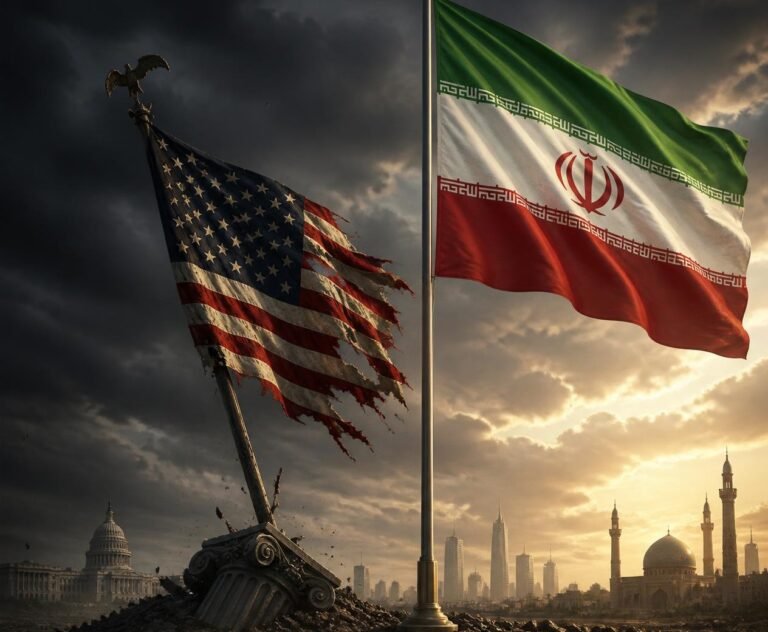
Today, at a time when Iran is facing illegal and brutal American and Israeli aggression, and with the Lebanese front being ignited, and the continued attacks on Gaza and Palestine…
Tehran does not stop commemorating Quds Day.
Rather, it commemorates it with even greater determination. Because this day is not merely a political occasion. Rather, it is an expression of a principled position. A position that sees in Palestine a humanitarian cause before it is a geopolitical one.
From here, Quds Day meets the Unity of the Arenas.
The first embodies the message and the symbolism. The second embodies the strategy and the battlefield.
Between symbolism and the battlefield, a new equation in the conflict is formed.
An equation that says:
- Palestine is not an isolated front…
- Rather, it is the heart of the conflict in the region.
- And Jerusalem is not merely a symbol…
- But the compass of position and direction.
Thus, the Palestinian cause remains present in both consciousness and the battlefield.
And thus, International Quds Day remains an annual reminder that the injustice against a people is capable of uniting entire arenas of history, geography, affiliations, and humanity amid unshakable partnership between Israel and United States.
For more such readings, join Zeinab Al Saffar’s telegram channel @ZSaffar.