Border Without Peace: Is Pakistan’s Escalation in Afghanistan the Beginning of a Broader Strategic Crisis? An issue that was once faintly marked has cropped up to become one more fault line between the South Asian politics. In just a few days, Pakistan has already witnessed a deadly wave of militant attacks on its land and responded with airstrikes far into the territory of Afghanistan, which has once again triggered one of the most acute and dangerous security challenges in the region. What seems to be a military reaction of tactics is even more significant: this is the beginning of a serious strategic stalemate between Islamabad and Kabul, and the future of counter-insurgency policy.
The provocative event was not the foreign invasion, but the chain of atrocious assaults on Pakistani land. A vehicle-based suicide bombing that took place in Bajaur District, Pakistan, on 16 February and killed at least eleven security men and a civilian child; Pakistani forces later eliminated all twelve attackers. Claiming that it was conducted by the Tehreek-e-Taliban Pakistan (TTP), it thus highlights the undying nature of militancy in the porous Afghan border. Just a few days later, at Bannu, a suicide bomber attacked a military convoy and killed two soldiers, including a lieutenant colonel, and renewed the fears of an increasing organized insurgent violence which had been spawned in the north-western side of Pakistan.
TTP Government Truce
The Pakistan counter-terrorism policy within the country has long been an amalgamation of kinetic action and negotiated ceasefires with insurgents. In late 2022, the TTP signed a truce with the government; however, the failure of the ceasefire has resulted in a renewed violence. The pattern of suicide attacks that have followed- attacking both civilian and military targets is recurrent- indicative of the difficulty in fighting an insurgency that cuts across the military, social and ideological support systems. The militants take advantage of the socio-economic dissatisfactions, rugged terrain and political loopholes caused by poor governance in the areas of borders. Strategically, the insurgency is not just a terrorism problem, but indicative of centuries of poor governance in the frontier provinces of South Asia.
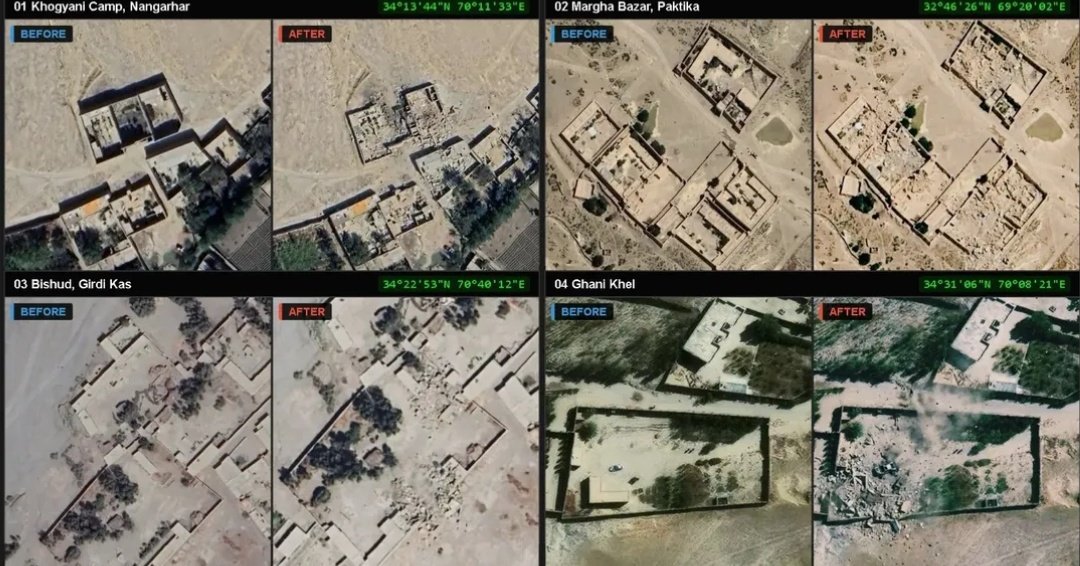
As a response to such attacks, Pakistan’s military declared a coordinated set of intelligence-led airstrikes within Afghan territory (deep inside Afghanistan) against what Islamabad termed as militant hideouts and terrorist camps of the TTP and its supporters. The strikes were said to have struck various places in the eastern provinces of Nangarhar and Paktika.
Islamabad’s Cross Boundary Measures
Pakistani sources indicated that seven targets were being targeted in precision attacks to destroy militant command structures that they claimed were alleged to be planning and orchestrating cross border attacks. The direct effect of such strikes was the high number of civilian casualties which was highlighted by the Afghan officials who reported that houses and even a religious academy were targeted which led to dozens of casualties and injuries, including women and children. The government of Kabul denounced the move as an infringement on the sovereignty of Afghanistan and threatened to retaliate accordingly in case the incursions were not stopped.
This contrast in the narratives demonstrates the geopolitical dilemma of the core of the crisis: Islamabad is categorical about the need to undertake cross-boundary measures to secure its citizens against militant sanctuaries, and Kabul denies Pakistan and represents the strikes as an aggressive encroachment. The diplomatic tension that is created is not a novelty but is increasing. Organizational efforts at negotiation in the past such as Qatar-mediated negotiations and ceasefire negotiations have failed or produced minimal outcomes and the result has been cycles of violence that undermine trust on both parties.
Strategic Risks for Pakistan and Afghanistan
The situation is growing and has serious strategic risks. First, it intensifies an old security dilemma between Pakistan and Afghanistan; two nations that share a border that is rugged and difficult to control with some 2,600 kilometers. This porosity is taking advantage of by militants, who find it very easy to go through checkpoints and even tribal territories. Any military action beyond national boundaries can provoke the feeling of nationalism, strengthen political standpoints, and complicate the possibility of a diplomatic solution.
Second, Afghanistan has the danger of civilian deaths that would expand the scope of the conflict to the non-militant world. By creating a false impression of what is right and what is wrong, the concept of precision operations unintentionally attacking the non-combatants, intensifies the relevance of the security policies and makes the propaganda of the militant more powerful. The armed groups can use the sense of outrage to recruit, fundraise, and spread anti-state sentiment not only in Afghanistan but in the region. Such a dynamic poses a danger of turning an isolated insurgent violence into an expanded insurgency that has transnational aspects.
Third, to Pakistan, the internal counter-terrorism policy or the external escalation policy relates to a more strategic panic concerning its own security autonomy. The leadership of Islamabad has been accusing the Taliban government of Afghanistan of providing safe haven or at least not stopping the insurgents activities on the Afghan soil. Kabul, in its turn does not accept these assertions and demands the honor of sovereignty. Any major escalation is closely monitored by regional powers, and any external interference may find its way into the traditionally bilateral dilemma.
Pakistan’s Escalation in Afghanistan: Expensive Endeavor
The financial cost is also very serious. The instability on the border influences the trade, cross-border humanitarian movement, and investment confidence. Violence, limited mobility and disturbed livelihoods affect the local communities on either side of Durand Line and these conditions are usually the root cause of further grievance as well as destabilization. However, strategic escalation also shows that there is a policy vacuum. It will not be possible to destroy the sophisticated networks of militancy that have taken root along the border through military action alone. Sustainable stability is a multi-pronged strategy: revitalized political involvement with the disenfranchised communities, specific socio-economic advancement in the border districts, regional intelligence sharing, and strong diplomatic relations to solve the cross-border conflict situations before it is too late to seek revenge.
With the accusations and condemnations thrown at each other, there is the danger of an unwanted escalation between Islamabad and Kabul. Every suicide operation, every airstrike, has a possible effect of escalating the conflict, attracting not only the local population but also regional forces. As much as national security is supreme to any nation, the security that is derived out of cross-border bombardment but without political advancement can be short lived.
This new wave of violence in a country that has been already devastated by the decades of insurgency and mistrust presents Pakistan and Afghanistan with the challenge of not only reevaluating their methods, but also reevaluating their vision of the peace. It is not merely whether this recent escalation can be contained, but whether both nations can redefine security in such ways that do not merely respond instantly to retaliation: can both Pakistan and Afghanistan develop a workable structure of cooperation that does not merely respond in retaliation across borders but goes to the root of insurgency?